Only Pay on Verified Savings: AWS Kubernetes Cost Reporting, Read Only
A Kubernetes cost reporting engagement is a paid, engineering-led audit that identifies Kubernetes spend leaks, delivers a dollarized prioritized action plan, and charges only on realized savings. It is not a dashboard subscription. Cost Beacon’s version of this audit averages a 32% bill reduction, uses read-only or agentless data collection, and ties fees to the money you actually save.
TL;DR:
- Cost savings depend heavily on underutilized resources; effective rightsizing can recover the largest portion of waste within weeks.
- The audit’s success relies on a thorough, layered analysis covering clusters, storage, load balancers, and cloud commitments, primarily on AWS.
- Only pay-on-savings models ensure fees are incurred solely on realized reductions, with verification through detailed, dollarized recommendations.
- Vendors should provide agentless, read-only data collection, avoiding write access or shared credentials to meet security and compliance standards.
- Continuous governance, monthly reviews, and anomaly alerts are crucial to maintain savings over time and prevent drift back to higher costs.
Table of Contents
- What does a kubernetes cost reporting audit include?
- How much can you actually save?
- What does the audit process look like week by week?
- How do you vet a kubernetes cost audit vendor?
- How do you cut costs without breaking a regulated workload?
- What Cost Beacon’s approach gets right that pure automation misses
- Start your pay-on-savings audit with Cost Beacon
- Sources
What does a kubernetes cost reporting audit include?
A serious audit covers every layer where Kubernetes spend hides, not only the top-line AWS bill. That means clusters, namespaces, pods, persistent storage, load balancers, NAT gateways, and any commitment or savings plan opportunity sitting unused on the account. Since most enterprise workloads still run on AWS, the strongest audits are built around Amazon EKS billing patterns, EC2 instance families, and EBS volume utilization first, with GCP and Azure coverage layered in where relevant.
Data collection pulls from three places: the AWS Cost and Usage Report for billing-level truth, Prometheus or metrics-server for actual pod-level resource consumption, and the Kubernetes API for metadata like labels, requests, and limits. None of this requires write access to your clusters. An agentless, read-only collection model avoids sharing kubeconfig files or cloud credentials, which is exactly the kind of detail security teams ask about before they approve any external audit.
What you get back should look like a financial document, not a technical dump:
- Prioritized recommendations with a dollar amount attached to each one
- Effort-versus-payoff scoring so engineering knows what to tackle first
- Risk or confidence scores per recommendation
- GitOps-ready patches or manifest diffs your team can review and merge
- Recurring reports (weekly or monthly) that track drift against the baseline
| Deliverable | Format | Primary audience |
|---|---|---|
| Prioritized savings plan | Dollar amount per item | Finance and IT leadership |
| Rightsizing patches | GitOps-ready diffs | Platform/DevOps engineers |
| Risk/confidence scoring | Per-recommendation rating | Engineering reviewers |
| Recurring drift report | Weekly or monthly summary | Finance and ops |
How much can you actually save?
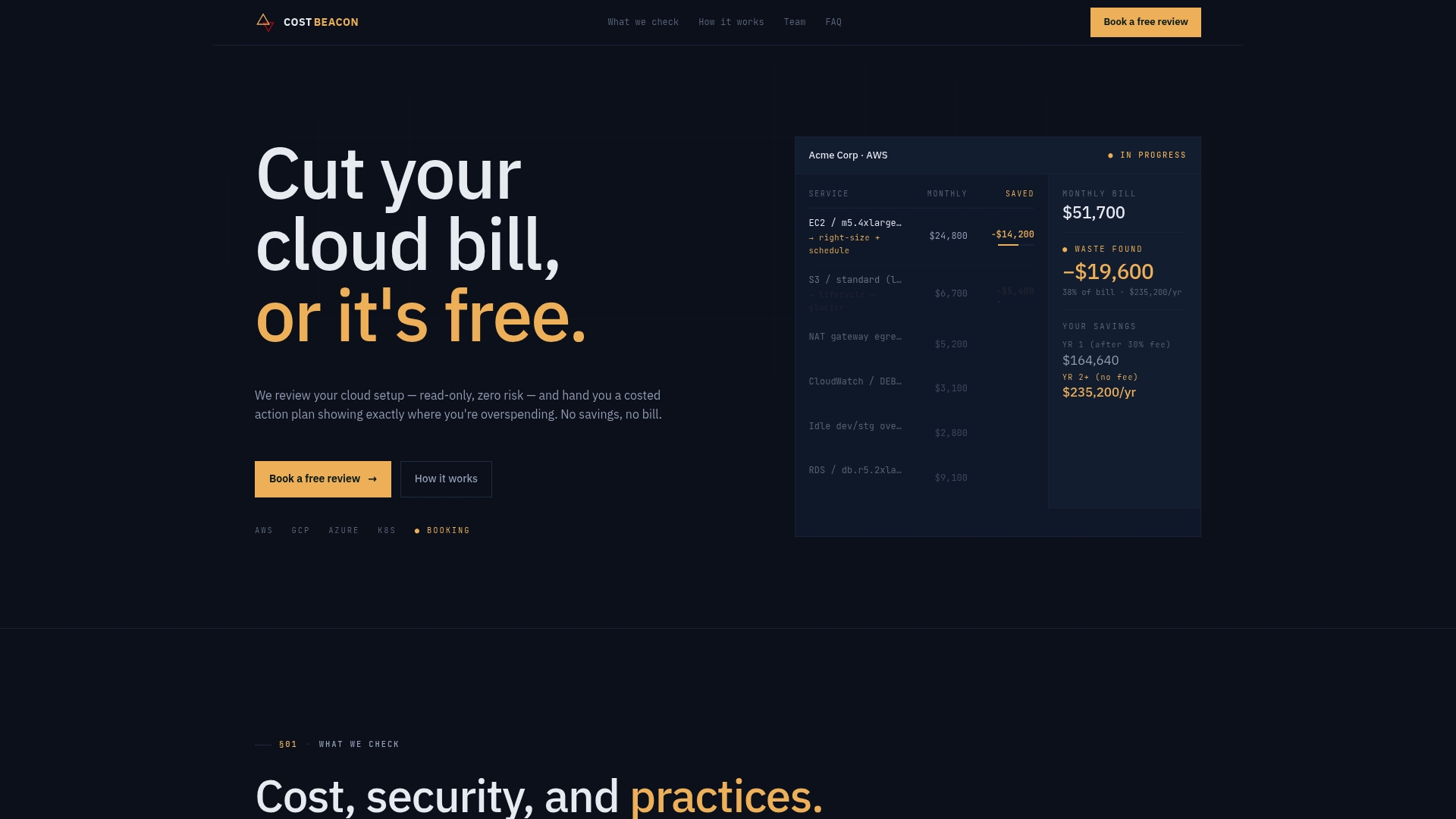
Audit-driven engagements typically land savings in the 20 to 50% range, and Cost Beacon’s own average across fintech, telecom, and other enterprise clients sits at 32%. The variation comes down to how bloated the environment was going in and how aggressively you act on the findings.
Four levers do most of the work:
- Rightsizing overprovisioned requests and limits on CPU and memory, which is usually the single largest recoverable chunk of compute waste
- Scale-to-zero for non-production environments during nights, weekends, and idle periods
- Reservation and savings plan alignment matched to your actual usage patterns rather than guesswork
- Storage and networking cleanup, including orphaned volumes, oversized load balancers, and unused NAT gateway paths
Quick wins like idle resource removal and rightsizing show up on the bill within weeks. Structural changes, such as reservation restructuring or governance rollout, typically play out over 30 to 90 days. That second phase matters more than most buyers expect: continuous governance, including monthly reviews and anomaly alerts, is what keeps savings from quietly decaying back within nine months. Showback reporting, simply letting teams see what their namespace costs, tends to change behavior on its own before any chargeback policy is ever enforced.
What does the audit process look like week by week?
A well-run Kubernetes cost audit follows a predictable arc, which is exactly why it’s worth asking any vendor to walk you through their version of it before you sign anything.
- Kickoff and access (day 1 to 2). You grant read-only access to billing exports and cluster metrics. No write permissions, no kubeconfig sharing, no changes to production.
- Discovery and visibility (week 1). The team maps top-line spend drivers, checks tag and label coverage, and reconciles what the AWS bill says against what the cluster is actually doing.
- Analysis and prioritized recommendations (week 2). Every finding gets a dollar figure, an effort score, and a confidence rating, delivered as a single prioritized plan rather than a raw list of anomalies.
- Optional implementation and validation (30 to 90 days). If you want hands-on help, engineers apply the highest-confidence fixes first, then validate the realized savings against the original baseline.
What you should walk away with after week two:
- A ranked list of fixes with dollar savings attached to each
- A separate list of low-risk quick wins your team can implement immediately
- A report format your finance team can actually read without a translator
How do you vet a kubernetes cost audit vendor?
Not every “cost audit” is the same product, and the gaps show up fastest in the contract terms and the access request, not the sales deck.
Ask these before you sign:
- Does the audit run agentless and read-only, and what exactly do you log during data collection?
- Are recommendations dollarized, or do you just get percentage estimates and vague “optimize this” notes?
- Does the pay-on-savings fee apply only to verified, realized savings, and over what measurement window?
- Who implements the fixes: your team, the vendor’s engineers, or a mix, and what’s the SLA for follow-up support?
- Can you review a sample report before committing, including how confidence scores are calculated?
Pro Tip: Ask specifically whether the “average savings” figure a vendor quotes is measured before or after their own fee. A 32% reduction quoted net of fees means something very different from one quoted gross.
Red flags worth walking away from: any vendor asking for standing write access to production, a fee structure based on projected rather than realized savings, or a report with no dollar figures at all.
How do you cut costs without breaking a regulated workload?
Cutting Kubernetes spend on a compliance-critical service the wrong way is how you end up explaining an outage to a board, not a finance committee. The fix is baseline discipline, not caution for its own sake.
For regulated or high-availability workloads, set resource requests off P95 or P99 usage, not averages, and keep a headroom buffer so audit-week traffic spikes or compliance scans don’t trigger evictions. Segment workloads by criticality: guaranteed quality-of-service tiers for anything customer-facing or compliance-bound, spot instances and scale-to-zero for everything else. Roll changes out in stages, starting with a recommendation-only observation window, then non-production environments, and only automate fixes in production once the pattern has proven safe.
Platform-level guardrails keep this from depending on individual judgment calls:
- LimitRanges and ResourceQuotas set at the namespace level
- Pod disruption budgets on anything that can’t tolerate an unplanned restart
- Cost gates built into CI/CD so oversized requests get flagged before merge, not after the bill arrives
| Monthly KPI | What it tells you |
|---|---|
| Cost per namespace | Where spend concentrates and whether it tracks usage |
| Rightsizing adoption rate | How many recommendations actually got merged |
| P95 request-to-usage ratio | Whether headroom buffers are still appropriate |
| Incident/eviction rate | Whether cost cuts are affecting reliability |
What Cost Beacon’s approach gets right that pure automation misses
Automated scanners find anomalies. They don’t tell you which fix is safe to ship first, and they rarely put a dollar figure next to a rightsizing suggestion in a way finance can sign off on. Cost Beacon pairs AI-driven analytics with engineers who actually validate each finding before it lands in your prioritized plan, which is the difference between a list of suspicions and a plan you can execute against.
That combination is why the average bill reduction across fintech, telecom, and other enterprise clients lands at 32%, delivered under a pay-on-savings model where the fee only applies to money you actually keep. The upside runs past the bill, too: tightening resource requests and cleaning up access patterns tends to improve security posture alongside cost.
— Aaditya Parashar
Start your pay-on-savings audit with Cost Beacon
Cost Beacon is the alternative to hiring a full-time FinOps team or betting on a dashboard subscription to catch what it can’t fix: engineers who validate every finding and a fee that only applies once you’ve banked the savings. No retainer, no upfront invoice, no risk if the numbers don’t move.
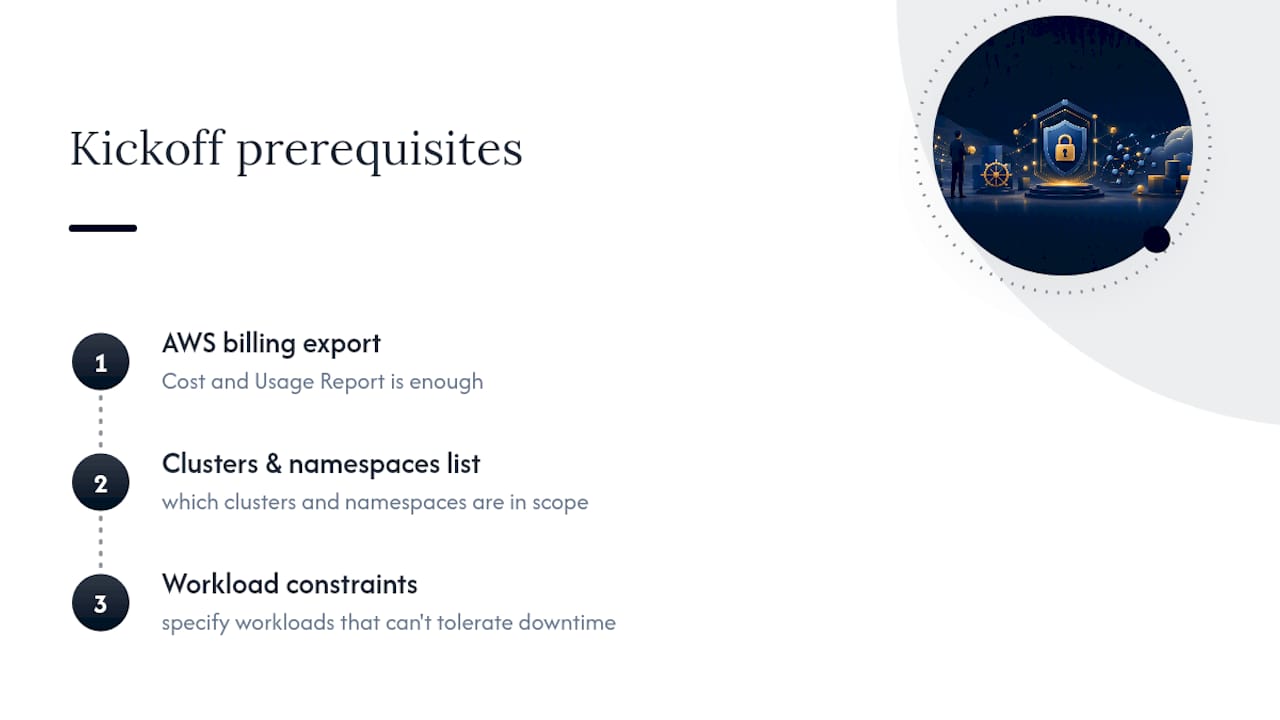
To move fast on kickoff, have three things ready: a read-only AWS billing export (Cost and Usage Report access is enough), a list of the clusters and namespaces in scope, and any constraints on workloads that can’t tolerate downtime during testing. From there, the audit runs on read-only, agentless access, meaning your security team never has to hand over write permissions or kubeconfig files.
The fee only applies to savings you actually realize, so there’s no cost to finding out what your clusters are quietly wasting. Head to Cost Beacon’s cloud cost and security review to request an audit scoped to your AWS and Kubernetes footprint, with engineering-led implementation support available if you want it.
Sources
For readers who want to dig into the technical and security foundations behind these audits:
Aaditya works on cloud cost and platform engineering at Cost Beacon, mostly on AWS and Kubernetes estates that grew faster than anyone planned for.
 Cost Beacon